
Cleaning service agreement template
A written agreement sets expectations before the first visit: what you clean, what it costs, and what happens when plans change. Below is a plain-English checklist of the sections most residential cleaning agreements cover, plus an editable template you can adapt.
This is general information, not legal advice. Laws differ by state and country, so have a local attorney review your final agreement.
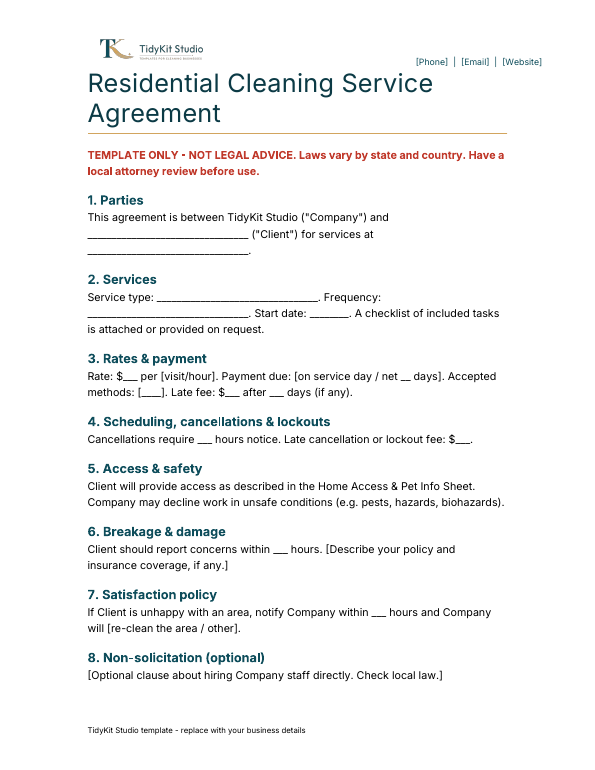
Sections to include
- Parties and address - your business name, the client, and the service address.
- Services and frequency - standard, deep or move-out clean; weekly, bi-weekly, monthly or one-time. Attach a task checklist so "clean" means the same thing to both sides.
- Rates and payment - your rate per visit or hour, when payment is due, accepted methods, and any late fee.
- Cancellations and lockouts - how much notice you need and what you charge if you can't get in.
- Access and safety - how you enter the home and your right to decline unsafe work (pests, hazards).
- Breakage and damage - how quickly clients should report problems and how you handle them. Only mention insurance you actually carry.
- Satisfaction policy - for example, re-cleaning an area if notified within a set window.
- Term and termination - notice needed to end recurring service.
- Signatures and dates.
Worked example
A bi-weekly client asks to skip a visit the night before. If your agreement says "cancellations require 48 hours notice; late cancellations are charged $___," you can point to that clause instead of negotiating on the spot. Fill in the number that fits your business.
Tips
- Pair the agreement with an intake form and a home access & pet info sheet so details aren't buried in texts.
- Keep door codes in a secure place, not on paper left in a car.
- Review your terms once a year.
The Client Paperwork pack includes this agreement template, an intake form and a pet/access sheet in Google Docs and Word.
How to fill in the template
Work through the template one section at a time and replace every blank and bracket. A few practical notes:
- Scope: list the rooms and tasks included in each service type. If you do a separate deep clean on the first visit, say so and say how it's priced.
- Exclusions: many cleaners exclude things like moving heavy furniture, cleaning biohazards, or work at heights. Write down whatever you won't do so it doesn't come up as a surprise.
- Supplies: state whether you bring products and equipment or use the client's, and how you handle client product preferences or allergies.
- Pets and access: refer to a separate access and pet sheet instead of writing door codes into the contract itself.
- Price changes: say how much notice you'll give before changing recurring rates.
Common mistakes to avoid
- Leaving blanks unfilled, or copying terms you don't actually enforce.
- Promising coverage, licenses or guarantees you don't have.
- Using vague wording like "full clean" without a checklist to back it up.
- Never updating the agreement after you change your policies.
Sending and storing signed agreements
You can print the agreement for an in-person walkthrough, or export it to PDF and use an e-signature tool. Keep a copy for every client together with their intake form, and send the client a copy too. If you change your terms, send existing clients the new version and get it signed again rather than quietly switching.
FAQ
Is a cleaning service agreement legally binding?
It can be, but that depends on your local laws and how it's written. Use a template as a starting point and have a local attorney review it.
Do I need a contract for one-time cleans?
Many cleaners use a shorter version for one-time jobs that covers scope, price, cancellation and access.
Can I edit the template in Google Docs?
Yes. Upload the .docx to Google Drive and open it with Google Docs.
Get the free pack